



Having been based in Greece for the past 15 years, I’ve spent each summer hopping between Greek islands, staying in bougainvillea-shaded guesthouses, scoffing fresh seafood in rustic tavernas and swimming from beaches the colour of chalk. But with August temperatures becoming increasingly hard to bear, I’ve been searching for a cooler alternative.
So when I recently met a suntanned Scandi who boasted that Sweden has more islands than anywhere else in the world (267,570, apparently), I took up the gauntlet. (What the bombastic Swede neglected to mention is that a lot of them are just whale-size humps surrounded by bottle-green waters that seem forbiddingly murky compared with Greece’s translucent blues and greens.)
Swapping high-factor sunscreen for a knitted sweater, I set out to see whether hopping between Swedish islands could be as good.
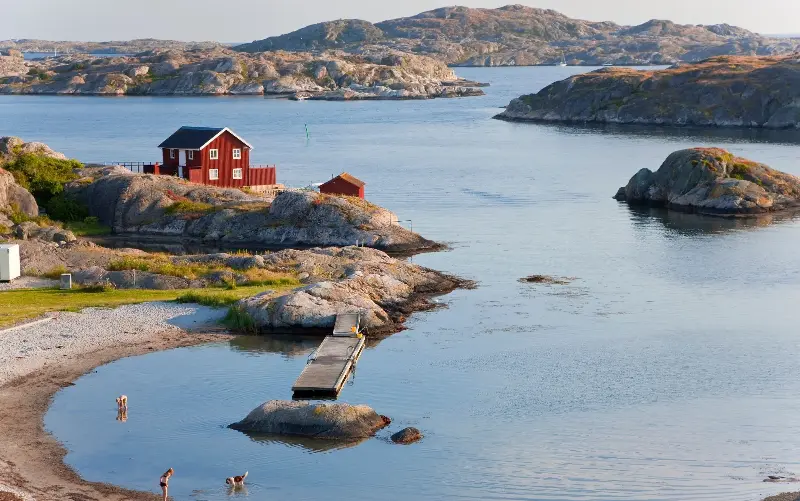
In the west-coast province of Bohuslan, where I started my trip, there are 8,000 islands alone, which is more than there are in the whole of Greece. With a distinct chill in the air, I caught a bus from Gothenburg and travelled through countryside spiked with bright green poplars to catch my first ferry.
Forty-five minutes north of Gothenburg, the Bohuslan archipelago stretches to the border with Norway. Punctual to the second, our ferry was waiting to carry us sedately across the narrow crossing from little Koon, accessed via a bridge to the mainland, to even smaller Marstrand. Greek ferries typically involve clouds of diesel, honking cars and sharp-elbowed grannies, but here there was only the gentle hum of electric engines and the even gentler lilt of Swedish chatter.
Framed by a striking 17th-century fortress, Marstrand was packed with yachties and weekending Gothenburgers. Shops stocked with jaunty striped jerseys and slick yellow oilskins confirmed the island’s appeal to the sailing fraternity.
I’d arrived just in time for fika, the Swedish afternoon snack that’s taken around 2pm, the time most Greeks sit down to lunch. After a feather-light kanelbullar (cinnamon bun) at island bakery Bergs, where they’ve been making everything from scratch for more than a century, I dumped my bag at the Grand Hotel Marstrand and set off to explore.
I hiked around the tiny island’s rocky coastline, enjoying a perfect-for-walking 16C temperature. Along car-free cobbled alleys, I climbed to Carlsten Fortress, stopping off to admire houses decorated with the ornate gingerbread woodwork. Leading me through a succession of spooky tunnels, knowledgeable guide Frida regaled me with tales of cross-dressing prisoner Lasse-Maja, whose bodice-ripping autobiography was a 19th-century Swedish bestseller. “They say he was so attractive that men even fought over him,” she said admiringly.
If Marstrand, with its yachtie vibe, cobbled alleyways and historic hotels, was like a Swedish version of Greece’s Hydra, Stora Dyron, a 20-minute ferry ride to the north (from a ferry terminal at Rokan Bryggan), was more like a miniature version of the far-flung Greek island of Antikythera. Following locals pushing handcarts piled high with sugar, plants and children, I trudged along the single main road leading to the island’s only shop where I was informed that I could buy eggs, eat pizza or post a letter.
I was in the heart of wild west Sweden now: rare were the locals who spoke English and there were plenty of lost-in-translation encounters, including one with a waiter who suggested I try “cow on toast” (it turned out to be a beef sandwich).
Checking into Dyrons Vardshus, a cosy complex of renovated boathouses near the harbour, I hiked out along the Dyroleden trail. Stora Dyron is only a tad larger than Marstrand, but the three-mile trail which circumvents the island was surprisingly challenging. Clambering over high cliffs and scrambling along narrow ravines, I admired the island’s shy mouflon sheep (brought to Sweden in the 1930s), which cantered over the jagged rocks above with far more ease.
With around 200 permanent inhabitants, Astol, a short hop from Stora Dyron, is another tight-knit community. As I waited to board the ferry, islanders chattered loudly, making the trip seem like a social occasion. It was a far cry from the polite discretion of Marstranders, and for the first time I was reminded of ferry travel in Greece.
“Everyone knows everyone. If you go to village shops, you have to budget at least half an hour to catch up on gossip,” Astrid, from Gothenburg, who was visiting family, told me. She said that a lot of Swedish celebrities had bought houses here, but as I wandered around the boulder-strewn hillsides, I only saw cormorants diving for fish and a boy wrapped in a bath towel returning from a swim in one of the island’s creeks.
Built around a fjord-like port, this pocket-sized island had more than 20 trawlers up until the early 1970s. They have now gone, but Astol is still a magnet for seafood-lovers who flock here to bag a candlelit table at Astols Rokeri, where genial owner Joacim dishes up lightly smoked Swedish shrimps served with a dab of aioli, and a locally famous dill-spiked fish soup.
My final hop was to Kladesholmen. Despite plenty of contenders, it is known as Sweden’s herring island because of the many salteries, smoke houses and canneries that once operated here. At Salt & Sill, a stylish “boatel” built on a floating pontoon, I ordered the sillbuffé herring buffet: a mega spread of pickled fish served with dozens of different sauces.
Though small, Kladesholmen has a surprising number of attractions, including the Nordic Watercolour Museum. Set in a dramatic coastal spot, it is the only one in the world dedicated solely to aquarelles.
Nursing a thimble of berry-infused akvavit in the rooftop hot tub at Salt & Sill on my final evening, I watched white-sailed boats slicing back and forth across the Bohuslan archipelago’s dark waters beneath a sky full of marshmallow-pink clouds.
Much as I hated to admit it, trading Greece’s glorious beaches for a Swedish week of streamlined transport, sumptuous seafood and pleasant temperatures hadn’t been bad at all.
How to do it
Ryanair has return flights from London Stansted to Gothenburg from £35. Find information on public transport options at Vasttrafik.
Where to stay
In Gothenburg, stays at Sweden’s oldest hotel, Hôtel Eggers, where rooms start from £168, including breakfast. See Telegraph Travel’s complete guide to the city’s best hotels.
Elsewhere on the islands, Grand Hotel Marstrand has rooms from £169, including breakfast; Dyrons Vardshus has rooms from £107 or £61 per person for four people sharing; Hotel Strana has sea houses for four from £479, including breakfast; Salt & Sill has rooms from £112, including breakfast.
Where to eat
Vatten Restaurant & Café inside the Nordic Watercolour Museum; Astols Rakeri; Dyrobaren restaurant.
Heidi Fuller-love was a guest of the West Sweden tourist board