



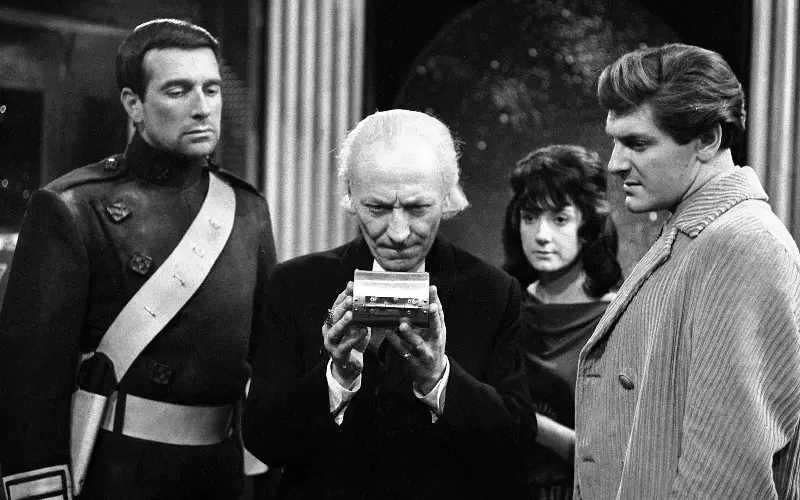
Your childhood heroes are in peril! Future Blue Peter presenter Peter Purves (here playing space pilot and time-traveller Steven Taylor) has been poisoned and is fighting for his life. Meanwhile, a terrified Brian “Play School” Cant (playing space security agent Kurt Gantry) is stalked by a Dalek. This is all before we then discover the metal meanies’ sinister plot to conquer the whole of the solar system by weaponising… time itself.
That’s the set-up for classic Doctor Who story The Daleks’ Master Plan, which has been largely missing since its original broadcast. Now comes the thrilling news that two episodes – parts one and three – from this monster-sized adventure have been rediscovered, and will be on iPlayer for us all to watch from April 4.
With episode two returned to the BBC in 2002 (and episodes 5 and 10 also in existence), we now have the opening three instalments – the first quarter – of the biggest, boldest Dalek story ever.
Here’s why it’s worth getting excited about the chance to watch “new” old episodes of The Daleks’ Master Plan…
More Daleks than ever
Broadcast over 12 weeks in 1965 and 1966, The Daleks’ Master Plan is the most epic Doctor Who adventure ever attempted. It had originally been conceived as a six-part story, in line with the Daleks’ previous on-screen exploits. Then, BBC controller of programmes Huw Wheldon insisted that “every possible effort” be made to feature the Daleks more frequently – apparently, his mother-in-law was a fan.
To fill the extra space, the story unfolds on an enormous scale, spanning multiple worlds in the past, present and future. The plot is relatively simple: the Doctor (William Hartnell) discovers the Daleks in league with various aliens – and the treacherous leader of humanity Mavic Chen (Kevin Stoney) – to develop a super new weapon, the Time Destructor. To stop them, the Doctor steals a vital component of the device, and the Daleks then pursue him through all of space and time – including to the building of the pyramids in Egypt and to a cricket match at the Oval – before a final, shocking confrontation where the Time Destructor is set off. It is ambitious, thrilling and brutal.
The plot to sack Doctor Who’s star
It wasn’t an easy story to make, and some of that tension is palpable on screen. New producer John Wiles had a rocky relationship with Hartnell. Appearing on Desert Island Discs in August 1965, the star noticeably praised Verity Lambert, the first producer of Doctor Who, referring to her in the present tense as the show’s current boss, despite the fact he’d been working for months with her successor. Then, Wiles decided to write out companion Vicki (Maureen O’Brien) without consulting her or Hartnell – the first the actors knew of it was when they received the scripts. There’s evidence of further arguments between star and producer, and by the time The Daleks’ Master Plan was in production, their relationship was so bad that Wiles wanted to write Hartnell out of Doctor Who. Instead, BBC management decided to move Wiles on to other projects.
A Doctor Who legend joins the show
Fans of Doctor Who have always held dear the character of Brigadier Lethbridge-Stewart (Nicholas Courtney), who would become a series regular in the 1970s opposite the Third Doctor, Jon Pertwee. But, in scenes not seen since 1965, we now get to witness Courtney’s debut in the show, here playing space agent Bret Vyon.
As Purves told BBC news this week: “There was a great performance by Nick Courtney playing Bret Vyon. [At the time] I was concerned very much that he was there as a replacement for me. As it happens, he got killed in episode four.” Nonetheless, Purves had good cause for concern…
The Doctor’s companions are killed off for the first time
With her introductory story missing, the first episode of The Daleks’ Master Plan now marks the earliest screen appearance of Adrienne Hill as companion Katarina. But, in a shocking development for the series, she doesn’t make it out alive. A handmaid from ancient Troy, the character was brought on board the Tardis, only for Wiles and the show’s story editor to have a late change of heart. Deciding to kill her off. In effect, that meant that the very first scene Hill filmed upon joining the show was her death, pushed out of an airlock into outer space. In her place, the Doctor and Steven are then joined in the Tardis by space agent Sara Kingdom (Jean Marsh) – who also meets a brutal end in the adventure’s final episode. Two companions killed in one story remains a Doctor Who record.
Does this discovery show the way for more episodes to be recovered?
Today, it seems odd that TV networks didn’t archive programmes. At the time, there were strict limits on how often the BBC could show repeats, largely due to pressure from unions to ensure actors and crew were kept steadily employed. Videotape was expensive and, with little call for reruns, tapes were routinely wiped and reused.
But TV was also sold abroad. The process involved making a film print of the episode by filming a flat-panel screen as the programme was broadcast. The resulting negative would then be sent to one of various processing laboratories in London, which would send a positive print back to the BBC for technical review. If approved, copies would be struck from the negative for posting abroad. Until now, much of the effort to find lost episodes has focused on following paperwork related to film prints sent abroad. That certainly turned up several episodes, but nothing new has been discovered since 2013.
What’s especially thrilling about the two episodes announced this week is that they are both technical review copies which seem never to have left the UK. These have been largely overlooked by researchers – until now. Film collector John Franklin, trustee of the charity Film is Fabulous, which acquired and returned these two episodes, says more review copies may well survive. “A lot of those probably ended up in private film collections,” he told the Doctor Who Missing Episodes Podcast. Research is ongoing, but part of the excitement about these two episodes is the promise of new lines of enquiry and the potential for further discoveries.
The Daleks may yet return again.
Doctor Who: The Daleks’ Master Plan will be on BBC iPlayer from April 4