



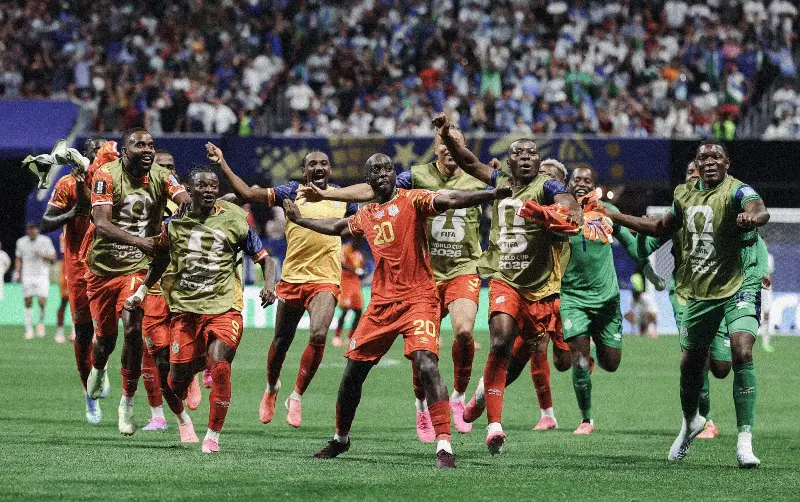
A new opponent awaits England in the World Cup round of 32 in the form of Democratic Republic of Congo.
England did not qualify for the 1974 World Cup when DR Congo, then Zaire, played against Brazil, Scotland and Yugoslavia, and Wednesday’s game in Atlanta will be the first meeting between the nations at senior level.
It will be an historic occasion for DR Congo, who reached the knockout stages of a World Cup for the first time courtesy of a victory over Uzbekistan.
They qualified as one of the eight best third-placed teams from a group that also featured Portugal and Colombia.
This is what England can expect from unfamiliar opposition, albeit a team with some familiar Premier League faces.
Robust back five who relish defending
There is Premier League experience across DR Congo’s defence, with Aaron Wan-Bissaka at right wing-back, Arthur Masuaku at left wing-back and Axel Tuanzebe at centre-back. Former Newcastle United defender Chancel Mbemba will be alongside him. Wan-Bissaka was once picked for an England squad, but did not play, leaving him free to represent DR Congo.
DR Congo conceded just two goals at the Africa Cup of Nations when they lost 1-0 to Algeria in the last 16, and they have continued that defensive excellence in North America.
Both Portugal and Colombia were limited to less than one expected goal when they faced the experienced back line. Portugal managed just nine shots and three on target despite having 75 per cent possession. Colombia were more effective with nine shots on target, but it took a 76th-minute goal by Crystal Palace’s Daniel Muñoz to finally break the resistance.
The way in which Tuanzebe, Mbemba and fellow centre-back Steve Kapuadi stifled Cristiano Ronaldo was particularly impressive as they repeatedly repelled crosses aimed towards Portugal’s captain. That should give them confidence for a duel with Harry Kane, although he will be more elusive.
Old school strike partnership
Yoane Wissa endured a difficult first season at Newcastle United following his move from Brentford, but he is DR Congo’s main outlet and source of goals. Wissa is a sharp mover and moderate aerial threat, who will peel off the shoulder of the last defender and look to take shots with minimal backlift inside the box.
Wissa will be partnered by 35-year-old Real Betis striker Cédric Bakambu, who defied his years in a lively performance against Portugal when he helped his team alleviate the pressure and move up the pitch. Bakambu scored for Betis against Nottingham Forest in last season’s Europa League, during Ange Postecoglou’s short stint in charge.
Modern centre-backs do not play against true strike partnerships regularly, and with England likely to dominate the ball, Ezri Konsa and Marc Guéhi may have to manage a two-on-two situation with plenty of space behind them.
England’s full-backs should find time and space
DR Congo will defend in a 5-3-2 against an England team likely to line up in a variation of 4-2-3-1. That means England should have a winger and a full-back against one DR Congo wing-back on the flanks. Unfortunately for England, Reece James, their best attacking right-back at the tournament, is an injury doubt.
Much of the responsibility for DR Congo will be on midfielders such as Watford’s Edo Kayembe to shuffle across to help Wan-Bissaka or Masuaku when England switch play.
The 5-3-2 offers coaches numbers when defending the box and the chance to cover the width of the pitch with a five, but the trade-off can be plenty of uncontested possession for the opposition. As with Portugal dominating the ball, Colombia had 66 per cent possession in their match.
DR Congo will accept that as part of their game model, but England should be able to find their rhythm early in the game. If Kane drops off, they will have a four against three in the middle, and it should be simple to circulate the ball from side to side if DR Congo’s wing-backs are pinned.
Test the wing-backs at the back post
England’s analysts have plenty of Premier League footage to pore over when they try to work out how to expose Wan-Bissaka and Masuaku. Masuaku, in his time at West Ham, was better in the opposition’s half than he was in his own.
Wan-Bissaka is a superb one-on-one defender, who loves to joust with wingers and win eye-catching slide tackles. His weakness throughout his career has been defending the back post when the ball is crossed from the opposite side, where he is liable to doze off and lose his man.
Wan-Bissaka has matured as a defender, but in those scenarios he does not always open his shoulders enough to see what is behind him. Nico O’Reilly or Marcus Rashford could profit from right-sided crosses.
Alternatively, Thomas Tuchel could use Morgan Rogers or Eberechi Eze off the left to cause Wan-Bissaka a different problem: a player who wants to receive the ball more centrally and leave Wan-Bissaka with no one to mark.