



Key Takeaways:
- NVIDIA has released Isaac Lab 3.0, moving open-source robot training framework to lightweight system that can run without installing the Isaac Sim app.
- The update adds the Warp Newton physics engine to simulate soft objects, cloth, and cables beside rigid robots.
- New tools like Isaac RLPT and LEAPP make it easier to fine tune robot foundation models such as Isaac GR00T and move trained AI policies to robots.
NVIDIA has launched Isaac Lab 3.0 on GitHub and announced the release on X on October 22, 2026, bringing a major architectural overhaul to its open-source robot learning framework.
We’re excited to announce the official release of NVIDIA Isaac Lab 3.0. 🎉
Isaac Lab 3.0 brings a new modular and lightweight architecture along with major new capabilities across the robot learning workflow: multi-physics and multi-rendering support, training at scale, and streamlined deployment on real hardware.
With Newton integration, the new OVRTX renderer, RL post-training, and LEAPP deployment, there’s a lot to explore.
Here’s a look at what’s new 🧵
(1/7)
— NVIDIA Robotics (@NVIDIARobotics) October 22, 2026
Table of Contents
A Lighter Setup and Multi-Backend Design
Isaac Lab 3.0 is a big change from the 2.x versions. Instead of forcing developers to rely on one setup, the update uses a task API that works through multiple physics and rendering backends.
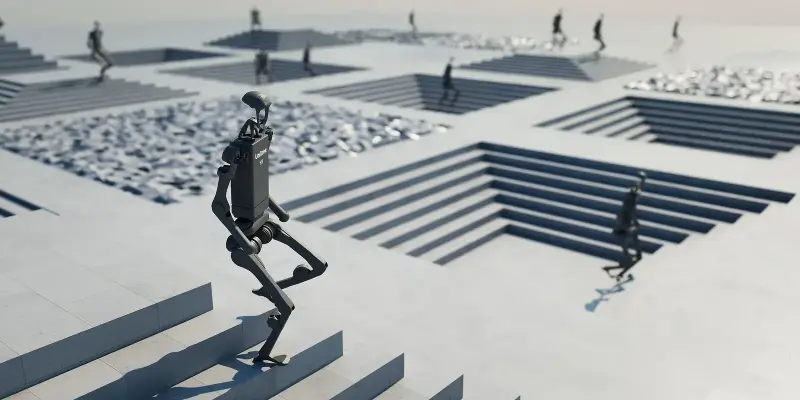
NVIDIA announce the official release of NVIDIA Isaac Lab 3.0
Read Next: NVIDIA and Mercedes-Benz Team Up for Self-Driving Cars
The framework is modular and supports less execution. This means developers can run fast robot training using the Newton physics engine or OpenVDB libraries and don’t need to install the Isaac Sim software. For projects that need full PhysX physics and RTX graphics, users can connect it with Isaac Sim 6.2.
To boost speed, simulation data is built on NVIDIA Warp and using a tool called ProxyArray, which shares data between Warp and PyTorch without slow copying steps. It uses CUDA graphs and fused kernels to cut down processing delays. NVIDIA recommends installing the update via the uv package manager, targeting Python 3.12, PyTorch 2.11 with CUDA 13.0, Warp 1.17, and Newton 1.6.1. A detailed guide is available to help teams move their code over from version 2.x.
Upgrades to Physics and Visual Rendering
The Newton Physics Engine
The biggest addition under the hood is Newton, a physics backend that lets developers mix and match different physics solvers in the same scene. This includes MJWarp for jointed robot bodies, VBD for cables and bendable objects, MPM for particles, and Kamino for closed-chain mechanisms. With these tools, developers can now train robots to handle soft objects, clothing, and experimental cables.
Independent Rendering and Photorealistic Environments
Visual rendering is separated from the physics engine, teams pick the best match for their hardware. Options include the kit-less OVRTX renderer for real time path tracing, a fast Newton Warp renderer, and standard Isaac Sim RTX. Visual viewing tools such as Newton GL, Viser, and Rerun are split out, and some Newton demos can run inside a web browser using WebAssembly.
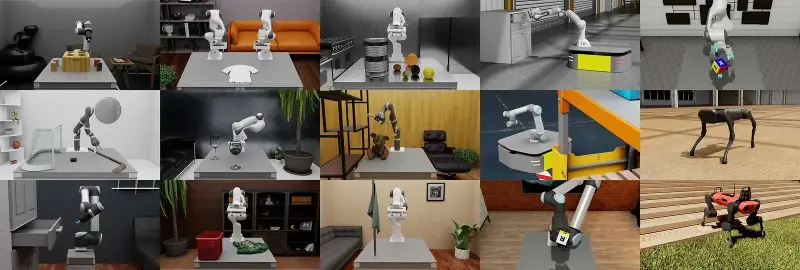
For training robots that rely on cameras, Isaac Lab 3.0 supports 3D Gaussian splats to bring 3D scans into the simulator. It integrates Cosmos 3-Nano Transfer, which turns depth maps from the simulator into video based on text prompts. Because physics and graphics are separated, teams can test whether a robot controller, such as the SONIC controller, works across different simulators.
Training Foundation Models and Moving to Robots
Isaac Lab 3.0 is built to scale multiple GPUs and server clusters. It introduces Isaac RLPT to help developers fine tune large robot foundation models such as NVIDIA’s Isaac GR00T. Demo from NVIDIA show robots using the update to learn hand movements and plug in cables.
To help move AI brains from computer simulations into machines, the release adds a packaging tool called LEAPP. LEAPP bundles a trained policy’s compute graph and settings into a portable file that supports camera feeds and data. It connects with Isaac ROS and includes examples for moving training to robots, including the Franka robotic arm, the Unitree G1 humanoid, and the ANYmal quadruped robot.
Read Next: NVIDIA and Cisco Reveals USFP for Massive AI Networks