



Did Germany anger the soccer gods when they ran up the score on Brazil, 7-1, in the 2014 World Cup semifinals in Belo Horizonte?
It’s as good an explanation for Germany’s sudden collapse as one of the giants of global soccer in the decade-plus since Die Mannschaft last hoisted the World Cup.
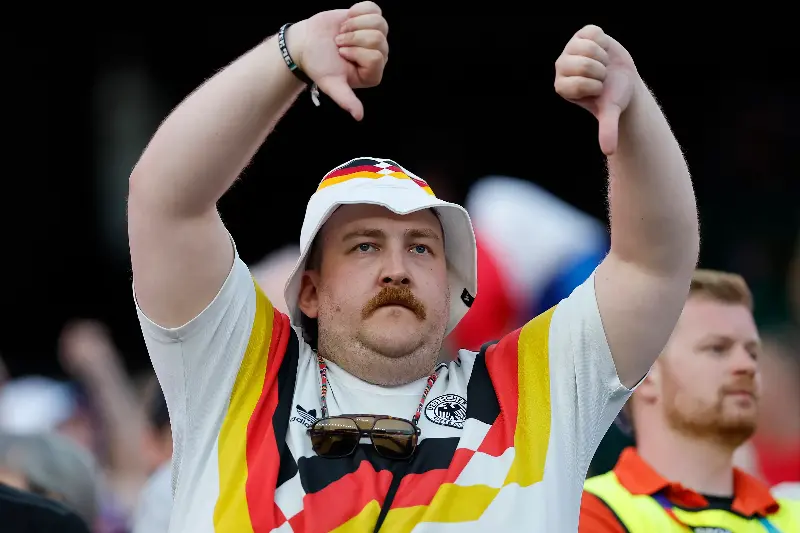
The four-time winners — only bested by Brazil (5) when it comes to stars on jerseys — have now made embarrassing exits from three straight World Cups. The group stage exits in Russia and Qatar were followed by Monday’s shocking elimination at the hands of Paraguay on penalty kicks in the round of 32.
Penalty kicks! You know the ‘Elfmeter’ shots that Germany historically never misses.
Germany had never lost a World Cup shootout before, and had won six of seven in major tournaments. Yet at Gillette Stadium outside Boston they had three players miss, including Jonathan Tah, who sent his spot kick higher over the bar than most Adam Vinatieri field goals in the same stadium for the Patriots.
“This is a complete disaster, yet another failure,” Fox pundit Alexi Lalas said in the postgame show. “I guess the silver lining is they got out of the group, but this is not what you expect from a German team. We keep expecting Germany to be Germany. Maybe, in this past decade, Germany has lost sight on what Germany is.”
ESPN blared a headline on its website Tuesday morning: “It’s official: Germany are no longer a soccer superpower.”
The Germans have had the ball go in the back of their own net in every game they’ve played at the World Cup since beating Argentina, 1-0, in the ’14 Final in Rio. That’s 10 straight games without a clean sheet. In that time Germany has lost World Cup games to Mexico, South Korea, Japan, Ecuador and now 34th-ranked Paraguay.
Kai Havertz, who scored the tying goal in the second half, was the first to miss his penalty and put the men in black, red and gold in peril.
“We had very big plans for this World Cup. It’s very difficult to disappoint again,” Havertz, the veteran Arsenal star, said.
In looking back, even though Germany advanced as a group winner here in this super-sized 48-team North American World Cup, this was a failure of a tournament for Julian Nagelsmann’s squad.
The 7-1 win over tiny Curacao — there is that scoreline again — in the opener no longer looks so impressive. Nor does the come-from-behind win over the Ivory Coast. And certainly not the performance against Ecuador in a 2-1 defeat here in our backyard — at the Meadlowlands — when the Nagelsmann and his players couldn’t seem to get on the same page on if they had actually played to win.
“You talk about expectations: It is 11 or 12 years and we have come up short,” Nagelsmann said. “It’s not enough for German football.”
Germany could pass the ball around the park for hours, but the slow build-up simply didn’t result in enough pressure. Not enough dangerous scoring chances in the final third. The squad lacked a sense of urgency from the start on Monday.
“We blew it,” team captain Joshua Kimmich told reporters after.
“As a child, when you watched the national team during tournaments, it was always semifinals, finals, or world champions. There was always lots of success. You grew up with that,” Kimmich said in blunt quotes distributed by the German Press Agency (dpa).
“The gods knew,” world-class writer Wright Thompson wrote for ESPN as he described the scenes in Rio during and after Brazil’s national horror from that July day when the Germans ran circles around the greatest soccer-playing country this world has ever known.
“A heavy winter thunderstorm in Rio de Janeiro is an unusual and portentous thing,” Thompson wrote.
Now the dark clouds hang over German soccer as the faithful from Munich to Berlin, and all points in between, try to make sense of what has happened to the mighty national team since that day.